Music for Mother’s Day

Bill and I avoided the crowded Mother’s Day buffets this year and went to two free concerts instead…much more enjoyable with less guilt!

First we saw Elizabeth McQueen up at the Bob Bullock Texas State History Museum. This month the Texas Center for Music History is sponsoring a free concert series on Sunday evenings on the museum’s terrace. Last year I had avoided going to outdoor concerts here since it’s all concrete. But while watching The Big Squeeze competition a few weeks ago, I realized that the terrace is shaded by the museum after mid-afternoon so these evening concerts are not unbearably hot.

Elizabeth McQueen performs with the Texas swing band, Asleep at the Wheel, but also does solo work. Our local NPR station KUT has been playing songs from her third and latest album, The Laziest Girl in Town. Elizabeth’s voice is clear and strong and she has a good stage presence.

The museum offers free admission on Sunday evenings during these concerts, so Bill and I looked around inside. Their latest special exhibit, Texas Music Roadtrip, celebrates famous Texas musicians including Janis Joplin, Bob Wills, Selena, Willie Nelson, and many more. I was thrilled to actually see Stevie Ray Vaughn‘s famous guitar, Number One, which has never been on public display before this exhibit. His custom Fender Strat  is immortalized in the Stevie Ray statue at Auditorium Shores.

Bill and I then walked a few blocks to the Texas State Capitol to hear a free concert by the Austin Symphonic Band. I know a few musicians who play in this band and have attended their other concerts around town. We arrived late to this concert (I had spent a lot of time looking at Number One) but we enjoyed selections by Henry Mancini and John Phillip Sousa. Both concerts had several hundred people in attendance.

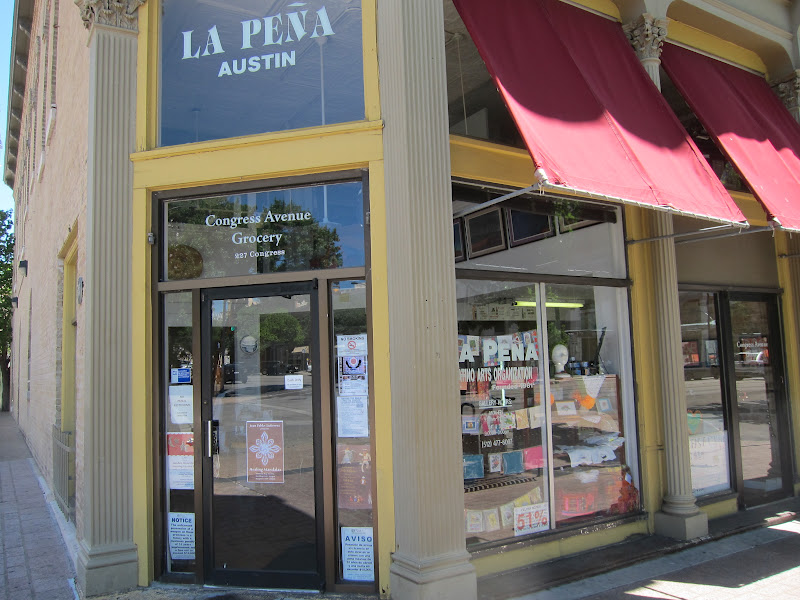
La Peña

I’m always on the lookout for a good breakfast taco. So when I’d heard that La Peña on Congress Avenue sells the best ones in town, I just had to investigate. Bill and I have walked by this building many times but never went inside.

I was very surprised to discover that La Peña is actually an art gallery that also sells some food. Founder Cynthia Perez created this gallery to showcase Latino art in downtown Austin. Usually the word peña means “rocky outcrop or summit” in Spanish, but it can also refer to “a grass-roots community meeting place where popular folklore and other artistic expressions accompanied by food and drink are showcased.” Cynthia and her sister Lidia used to own Las Manitas Avenue Cafe, a popular Mexican restaurant that used to be on Congress Avenue as well. I remember the controversy in 2008 when Las Manitas was closed to make way for a new Marriott hotel. (Construction on the hotel was subsequently delayed and is supposed to begin later this year.)  

La Peña’s current exhibit “The Amazing Talavera Style” displays painted ceramics made by fifth-grade students from East Austin’s Sanchez Elementary School. Another definition may be needed here: talavera is a type of Mexican pottery with a milkish-white glaze. The children’s creations are very colorful and creative. The upcoming exhibit, “Healing Manadalas” by Juan Pabloe Gutierrez, features traditional cut paper techniques and opens later this month.

Now about those breakfast tacos: La Peña contains a small food counter called Congress Avenue Grocery that sells pastries, coffee, soft drinks, and breakfast tacos. The tacos actually come from Elsi’s Restaurant, located north of downtown on Burnet Road. My egg-and-potato taco was quite delicious, maybe not the very best in Austin since it’s not made-to-order, but I will certainly return for more.  

Austin History Center

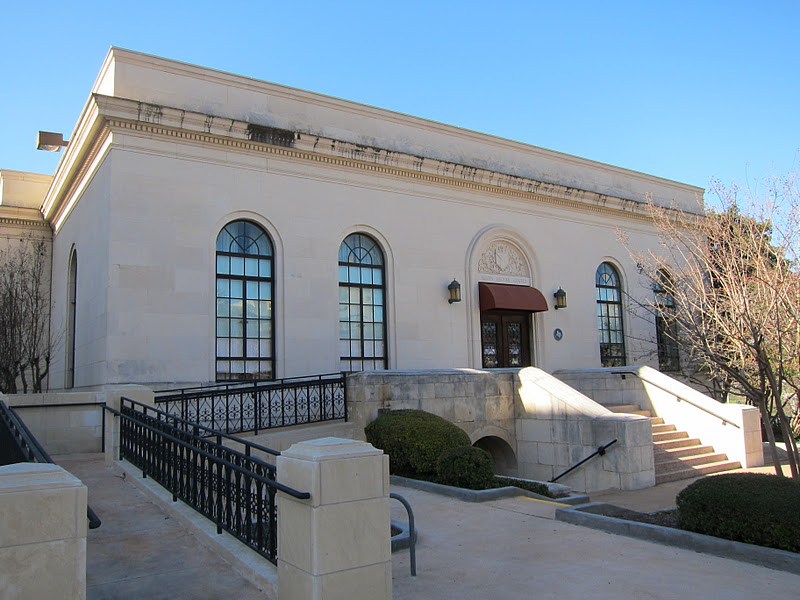
In my continuing quest to visit Austin’s many museums, last week I walked up to the Austin History Center, on the corner of Guadalupe and 8th Streets. I was surprised to learn that the Center is actually the local history division of the Austin Public Library. Built in 1933, this was originally the main library building, but became the Austin History Center in 1983 after the much-larger central library was opened next door.

The Center houses over a million items including photographs, maps, and recordings related to the history of our city. Items can be requested from the closed stacks and viewed in the Reading Room. A Mayors’ Room contains photographs of Austin’s mayors. Meeting rooms and a Reception Room are available for use by non-profit groups.
Two exhibits are currently on display: 
  • Sounding Together: 100 Years of the Austin Symphony  traces the history of the Austin Symphony Orchestra from 1911 to 2011. This exhibit has been on display since last fall. While I was browsing the displays, three women (maybe from the Women’s Symphony League?) were discussing what to do with the photos and artifacts when the exhibit ends next month. Their conversation was almost as interesting as the exhibit itself.

Texas State Archives

I recently visited the Texas State Archives and Library, located to the east of the State Capitol. I was curious to visit this building since learning that the archives had been moved here from what is now the Texas Capitol Visitors Center. This newer Archives building was completed in 1961 and is named for Lorenzo de Zavala, the first vice-president of the interim government of the Republic of Texas. Like most state buildings, Texas Lone Stars and statues of famous Texans are everywhere, including Sam Houston who stands guard outside the front door.

Unless you are a researcher, there’s not much to do inside. You can browse the display cases in the lobby or admire the large mural on the wall behind the reception desk. You can talk to the friendly receptionist. Or you can ponder what Texas archival materials are stored behind the glass walls on either side of the lobby…

Texas State Capitol

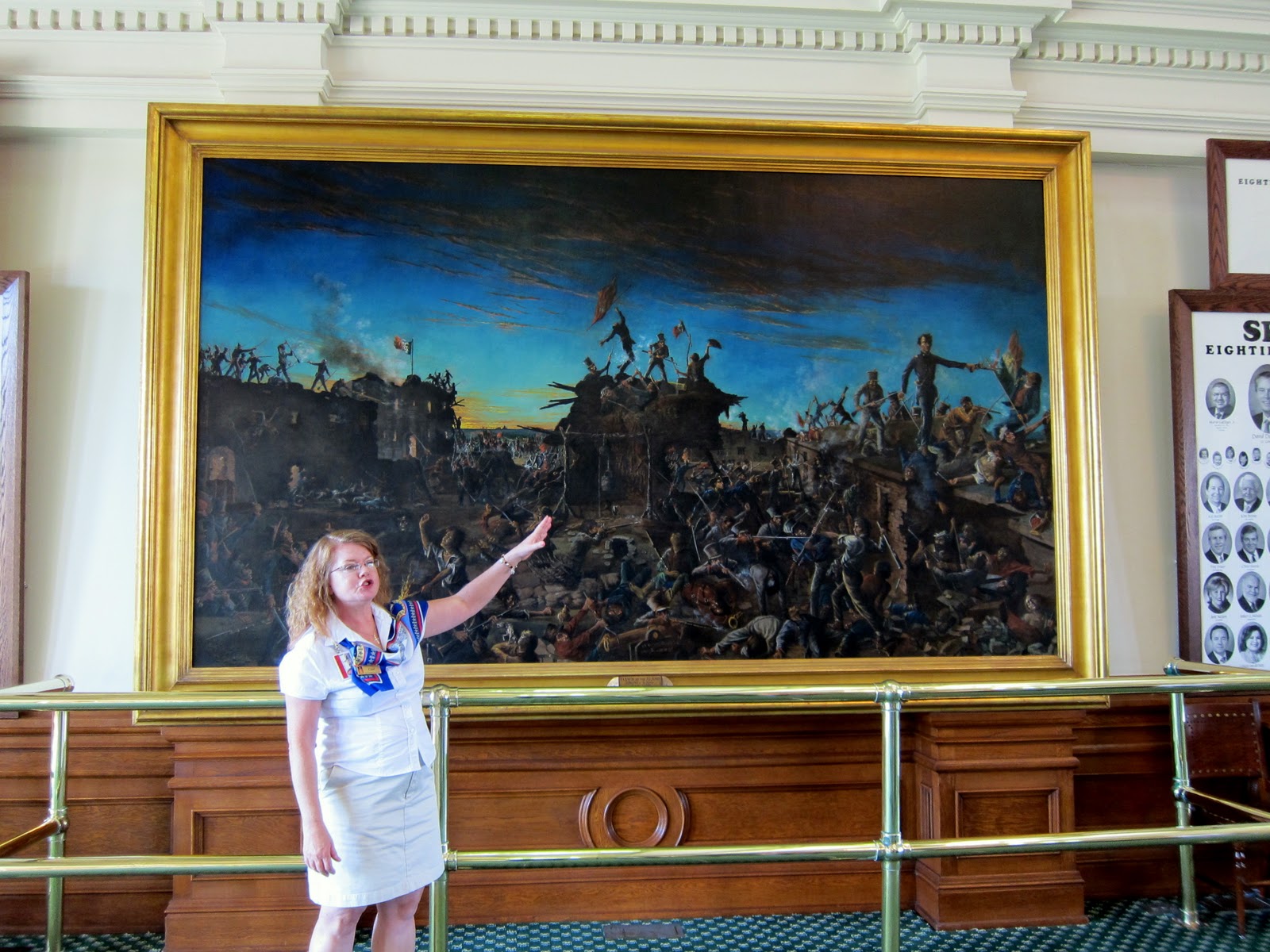
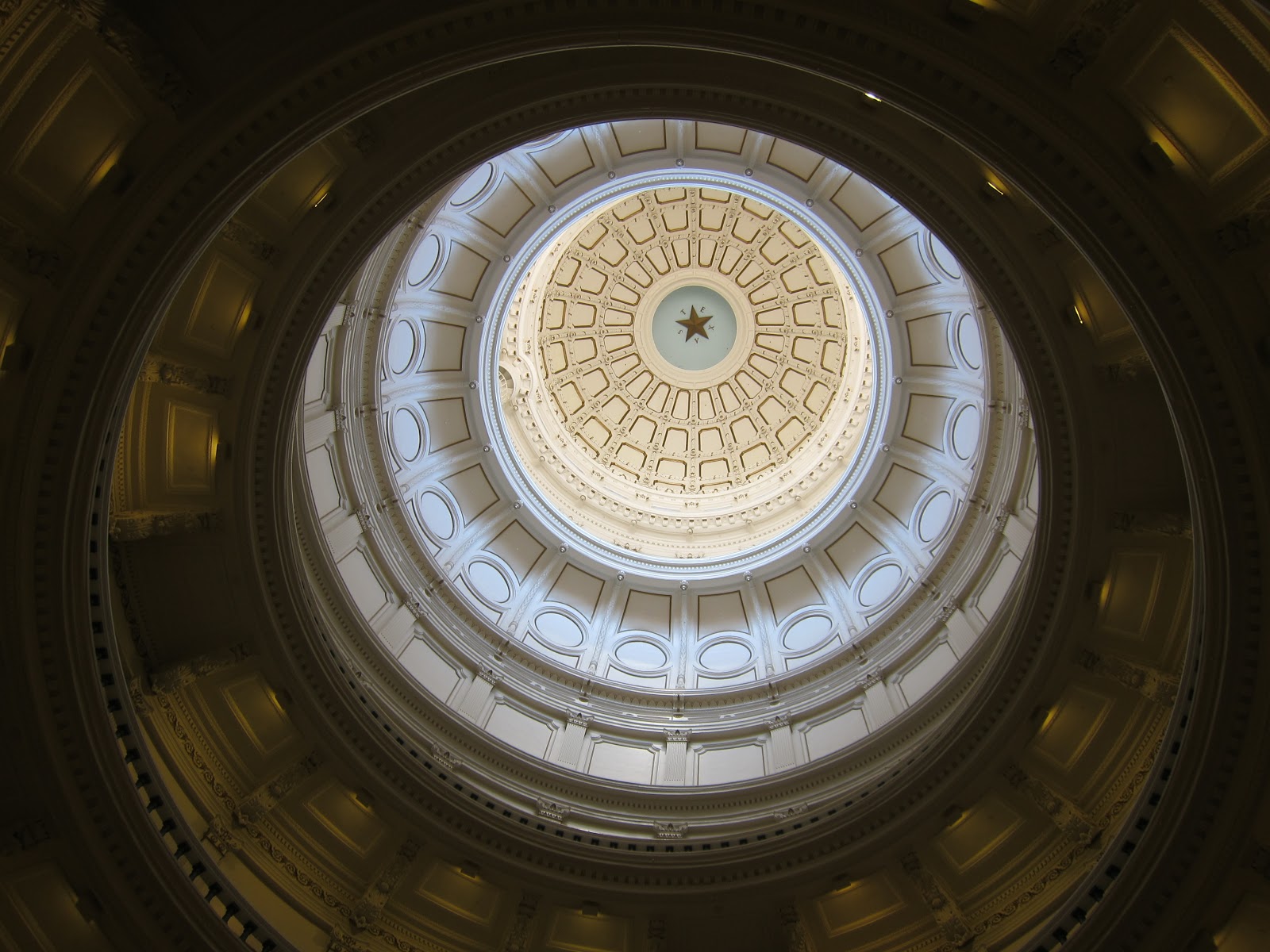
The Texas State Capitol is the centerpiece of the city of Austin. The building’s exterior is made of Sunset Red granite and was completed in 1888. A much-needed expansion (mostly underground) was finished in 1993. Texans will proudly tell you that this is the largest state capitol (in square footage) and is higher than the US Capitol.
Visitors must pass through metal detectors at the north or south entrances. Free guided tours meet in the lobby every day except major holidays. I’ve taken the tour many times and usually the tour guides are knowledgeable and friendly.
Portraits of previous Presidents of the Republic of Texas and Texas Governors hang in the central rotunda. George W. Bush’s picture is the most recent and hangs near the south lobby. When our current governor, Rick Perry, leaves office, his portrait will be hung in that spot and all the others will be moved one spot over. Some day I need to walk up to the fourth floor to see whose portrait is first up there. I’m guessing it’s Sam Houston, as the first elected President of the Republic of Texas, but it might be David G. Burnet, who was the interim President before him. 
Historically, Texans have not been fans of big government. As a result, the Texas State Legislature only meets on odd-numbered years for no more than 140 days. (The Governor can also call 30-day special sessions on specific topics.) Downtown Austin was noticeably busier this past spring when the Legislature was in session.
The House chamber on the west side of the Capitol is crowded with desks for the 150 state representatives who are elected for two-year terms. The speaker of the House is elected by the majority party.
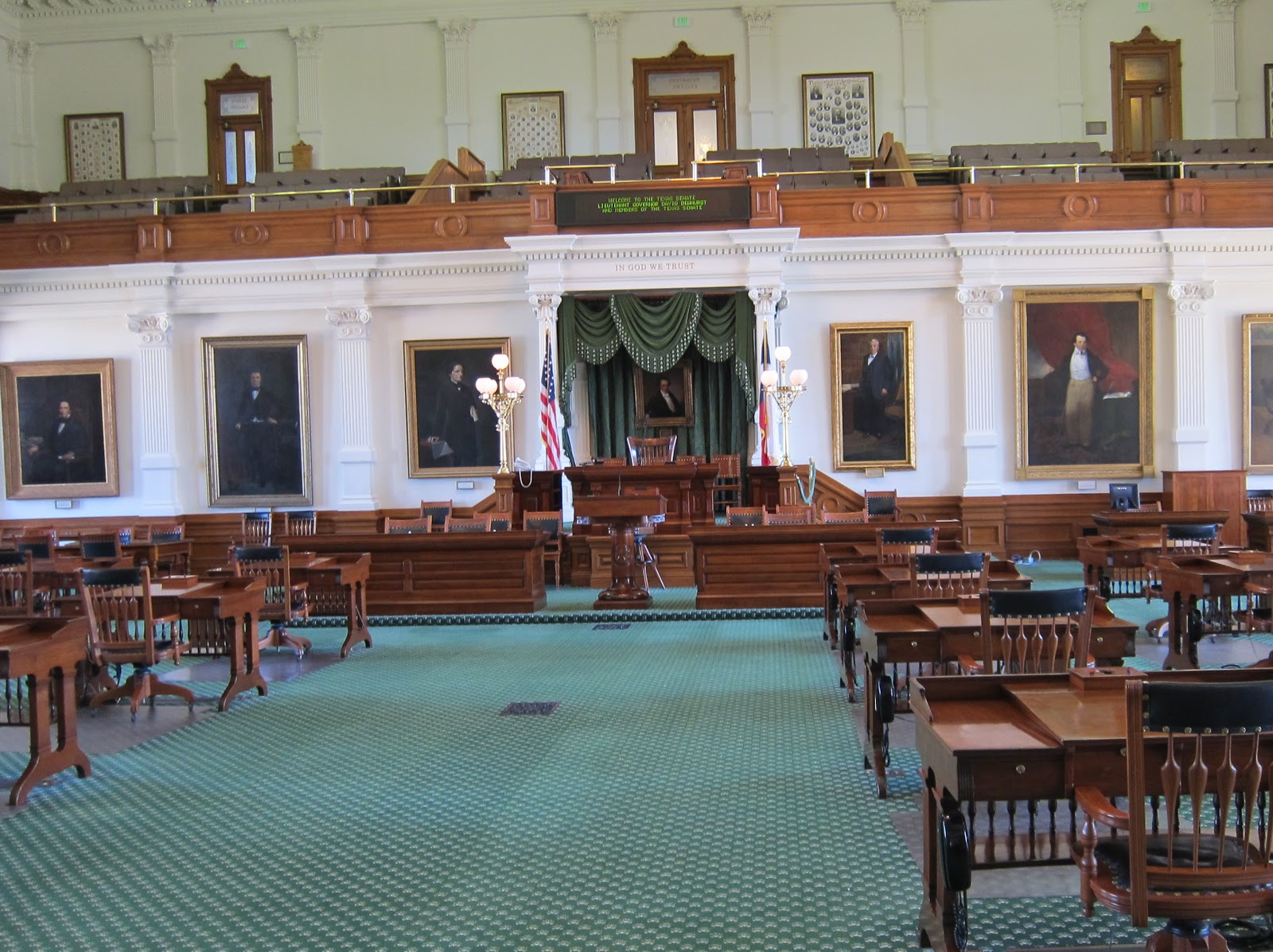
The Senate chamber at the opposite end of the second floor seems more spacious because there are only 31 state senators. They serve four-year terms and the Lieutenant Governor serving as presiding officer. Both chambers have an upstairs viewing gallery.
I often walk up to the Capitol just to see what’s going on. Sometimes there are demonstrations or marches on the front lawn. School groups perform on the front steps or in the rotunda. And the building and surrounding grounds are a popular backdrop for wedding and Quinceanera photographs.

The Bob Bullock Texas State History Museum

The Bob Bullock Texas State History Museum is located on North Congress Avenue between the State Capitol and the University of Texas campus. Besides the actual museum, the complex includes a cafeteria, a gift shop, an IMAX theater, a smaller theater with an interactive show called The Star of Destiny, and an attached parking garage. The gift shop is the best place in town to find Texas and Austin souvenirs and, yes, the final Harry Potter movie is still playing at the IMAX. 

This museum is named after Bob Bullock who was Lieutenant Governor for most of the 1990s. He is credited with championing the idea of having a state history museum. His statue is displayed in the rotunda. His closing words for every speech, “God Bless Texas,” are etched on the wall behind the statue.
The rotunda floor features a colorful mural by artist Robert T. Ritter: The Story of Texas: Born around the Campfires of our Past


I was surprised to learn that all items are on loan because this is a non-collecting museum. The permanent exhibits have not changed much since I last visited a few years ago. Texas history is traced on three floors:
Floor 1. Encounters on the Land (Native Americans and early settlers)
Floor 2: Building the Lone Star Identity (Texas Revolution through Civil War)
Floor 3: Creating Opportunity (20th century through today)

A special exhibit, Texas High School Football: More than the Game, is on display until January. I am not a football fan (and that’s an understatement!) but as a Former Band Mom, I seemed to have absorbed some knowledge of high school football here. So I enjoyed looking at memorabilia from teams, coaches, bands, and drill teams from Central Texas and other areas.

Dougherty Arts Center

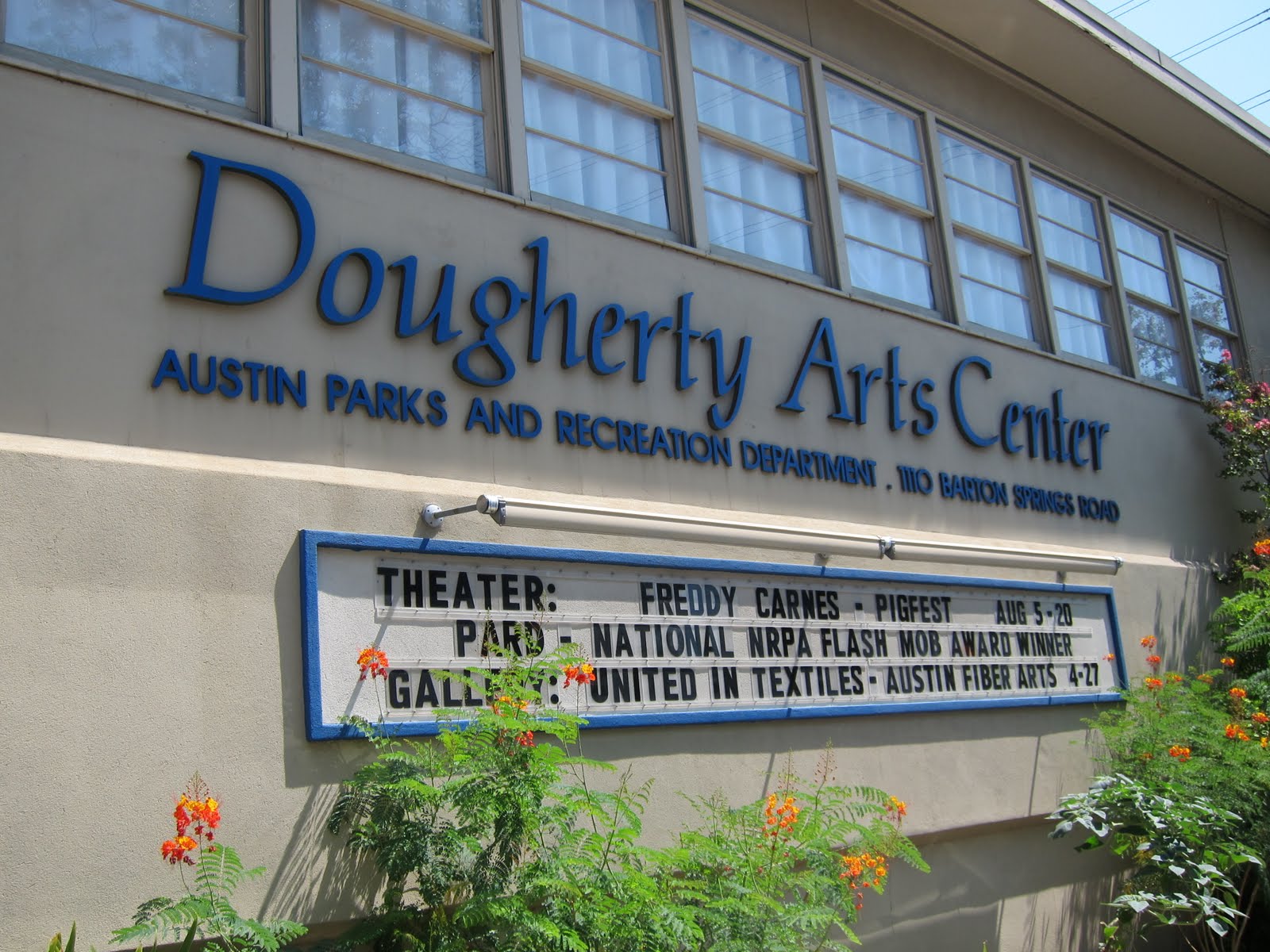
The Dougherty Arts Center is on Barton Springs Road, south of Lady Bird Lake, and just a short walk from downtown Austin. DAC is managed by the City of Austin’s Parks and Recreation Department . The building houses a theater, gallery and arts school. I had hoped to take a pottery class there this summer but it did not make the minimum enrollment. I’ll try again this fall. 

This month’s gallery exhibit is “United in Textiles,” featuring 48 pieces by members of Austin Fiber ArtistsI visited last weekend with a friend who knows about techniques such as felting and fabric collage. We were warmly welcomed by the AFA president and her husband and enjoyed perusing the colorful display.  No photos were permitted, but the AFA poster shows some examples:

Austin Museum of Art

Welcome to yet another day of 100°+ temperatures in Austin, Texas! Definitely an air-conditioned museum day. So I walked a few blocks up Congress Avenue to the Austin Museum of Art, where three exhibits are running through mid-September:

  •  Good Design: stories from herman miller  is a touring exhibition featuring design classics from the Michigan furniture company, Herman Miller. I learned that “Good Design Explores, Inquires, Engages and Endures.”  So I Explored the various displays. I Inquired if photographs were permitted (no). I was Engaged by Ergonomic Chair Design (and I now covet the Embody Chair). And I decided that Alexander Girard’s famous Eden design has Endured:
  • New Works: The Mona Lisa Project features interpretations of Leonardo da Vinci’s Mona Lisa. Photographer Rino Pizzi invited 16 Austin female artists to mimic the famous smile and pose and sit for a portrait session. The photographs were then printed to a variety of surfaces and personalized by each artist. Each interpretation was quite creative. I especially enjoyed this exhibit after seeing the original painting at the Louvre earlier this summer: 
 
Recently the AMOA board announced that they will not be renewing their downtown lease after October and will instead focus on their Laguna Gloria location near Lake Austin. That’s too bad…it’s been nice to have an art museum in downtown Austin.

Austin City Hall

Austin City Hall faces the First Street Bridge, set between Guadalupe and Lavaca Streets. The public is welcome to visit during business hours. There is plenty of parking in the underground garage.

The building was designed in the shape of an armadillo with a tail extending over Second Street. The odd angles don’t make much sense from street level but the outline becomes more apparent when looking down at the roof.


The inside atrium is lined with a stunning combination of Texas limestone and copper. Interesting artwork from local artists is displayed throughout the building. 

The City Council Chamber is located on the first floor. The room has a small stage because live music is included on the agenda of each regular City Council meeting.

Live from the Plaza concerts are held on the outside stage on Fridays in the spring and fall. 


Perhaps “you can’t fight City Hall”…but I’d recommend a visit!